Peptide calculator: from a vial to a dose you can draw
Somebody handed you a sealed vial, a bottle of bacteriostatic water and a bag of insulin syringes, and the instructions stopped there. This is the arithmetic nobody walked you through.
A peptide calculator converts a vial into a dose you can actually draw. You give it the vial strength in milligrams, the volume of bacteriostatic water you added, and the dose your protocol or prescriber specified. It returns the concentration in mg/mL, the injection volume in mL, the matching mark on a U-100 syringe, and how many doses the vial holds.
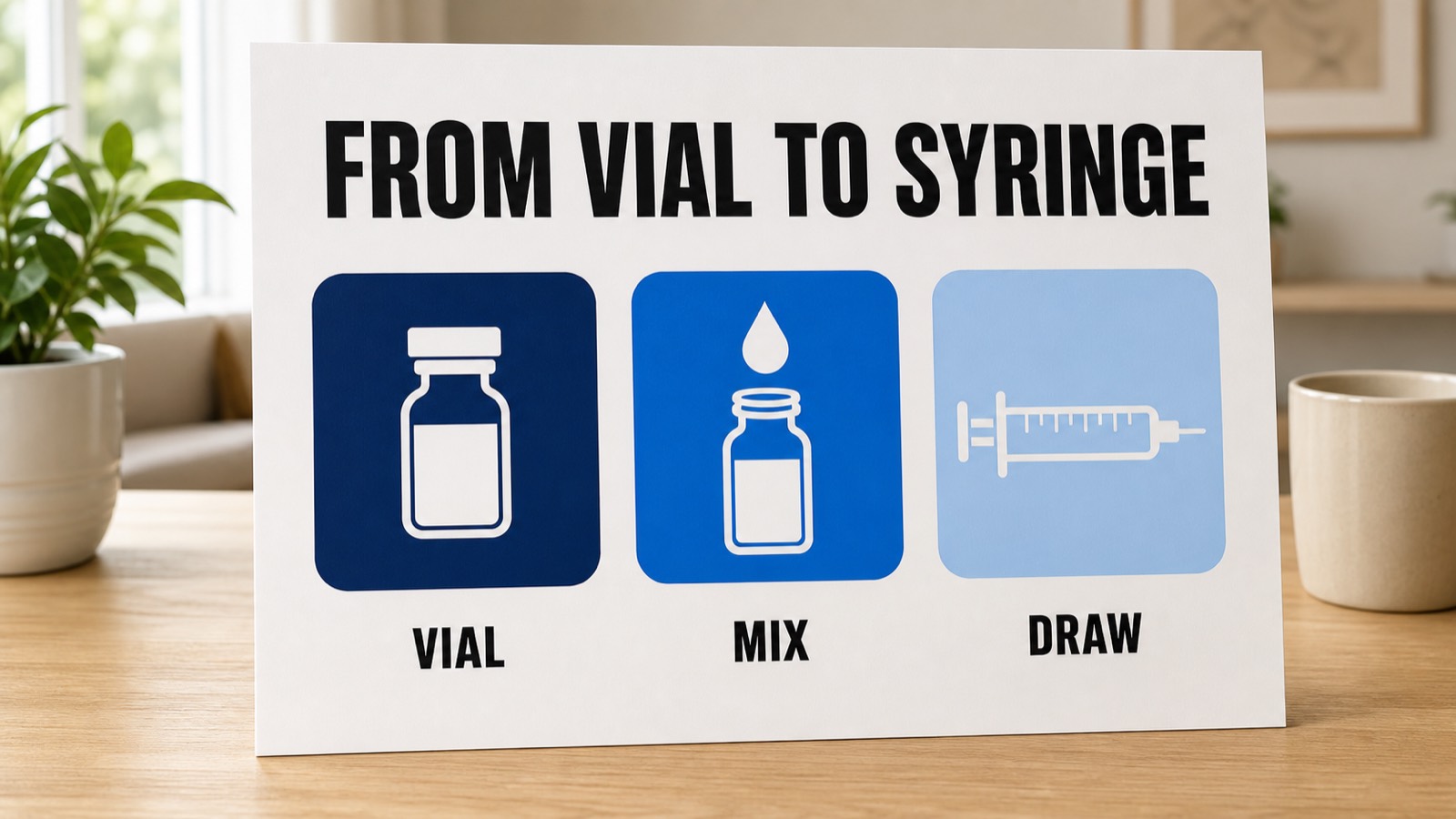
If you came from a pre-filled pen, none of this was ever your problem. You dialled a number, you heard a click, the pen did the measuring. A vial is a different object. It arrives as a dry powder or a clear liquid with a number on the label, and the number on the label is not the number you draw. Something has to happen in between, and that something is arithmetic.
The good news is that it is genuinely small arithmetic. Three divisions and one multiplication. There is no biology in it, no judgement call, nothing you need a background to understand. The reason it goes wrong is not that it is hard. It is that nobody sits down and does it slowly with you once, and the units involved are deliberately confusing.
So let us do it slowly once.
What does a peptide calculator actually do?
A peptide calculator is a reconstitution and dose conversion tool. It exists because three different measurement systems collide on your kitchen table at the same time, and the collision is where mistakes live.
The vial is labelled in milligrams. That is a mass, and it is the total amount of peptide sealed inside, not a dose.
The bacteriostatic water is measured in millilitres. That is a volume, and it is what you add to dissolve the powder. It contributes no drug whatsoever.
The syringe is marked in units. That is also a volume, and this is where almost everyone comes unstuck, for reasons we will get to in a moment.
Your dose arrives in milligrams or micrograms, from a prescription, a compounding pharmacy label or a written protocol.
A calculator's job is to walk that chain, from the mass in the vial through the volume in the syringe, and land on a single mark you can see. If you want it done for you rather than on paper, PeptideDeck runs a free peptide calculator that takes your vial size, water volume and target dose and returns concentration, injection volume, syringe units and doses per vial, with presets for common compounds and a choice of 1 mL, 0.5 mL and 0.3 mL U-100 barrels. Doing it by hand once first is still worth your time, because it means you can tell when any tool, including that one, has been given the wrong input.
One framing note before the numbers. Everything below converts a dose that somebody else has already decided on. It does not choose a dose, and nothing here is a recommendation to take any particular amount of anything. If you have a compounded GLP-1 from a pharmacy, the dose belongs on your prescription label. If you have a research peptide, those are sold for laboratory research use only and are not approved for human use, which is not a footnote. Either way, the arithmetic is the same, and the arithmetic is all this page claims to give you.
Why units on a U-100 syringe are volume, not milligrams
This is the single most important sentence on the page, so it gets its own section.
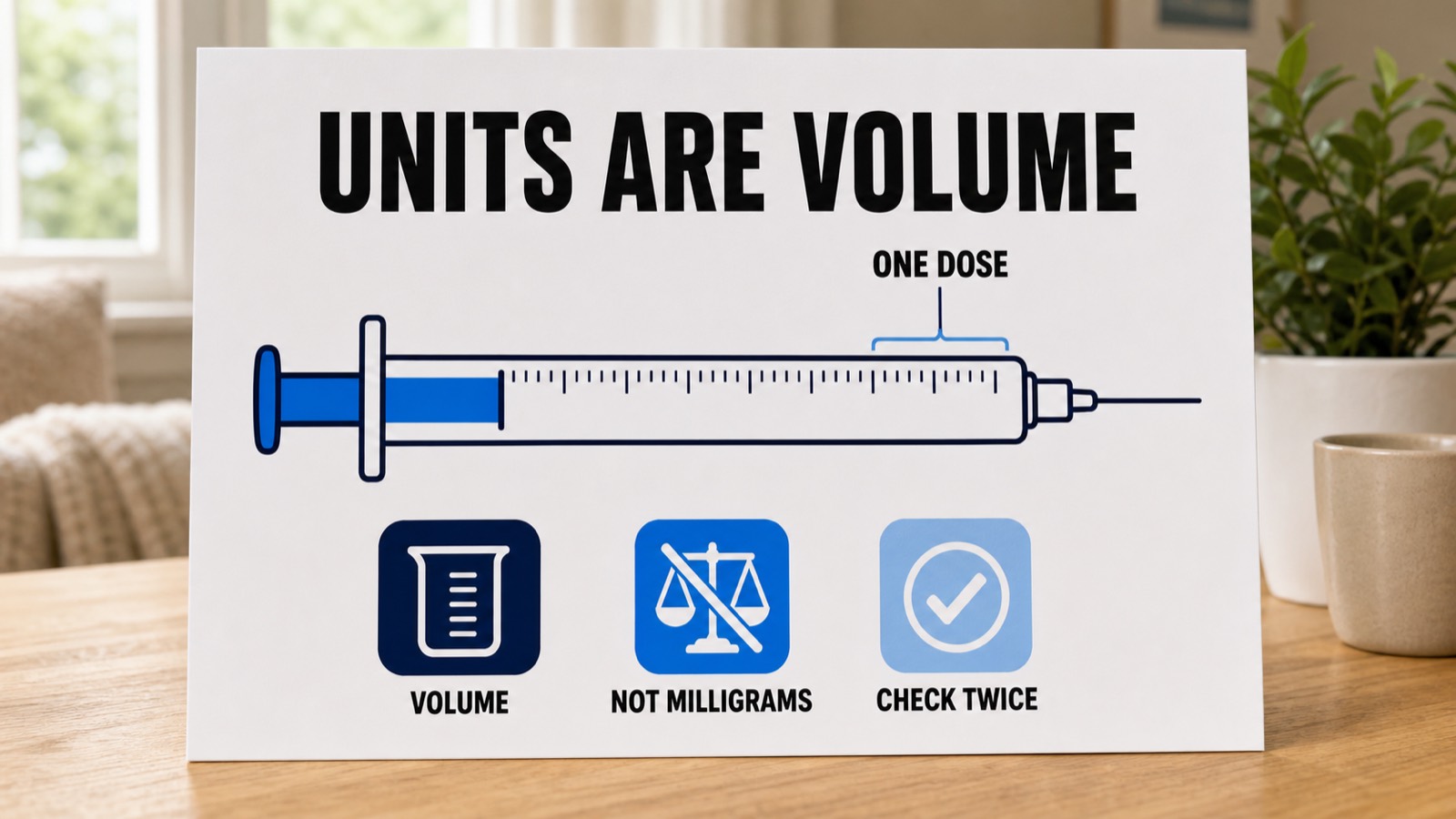
One unit on a U-100 insulin syringe is one hundredth of a millilitre. That is the entire definition. U-100 refers to insulin at 100 units per millilitre, which is where the scale came from, but the marks themselves are just volume ticks. A 1 mL barrel is divided into 100 of them.
Units are not milligrams. Units are not micrograms. Units are not IU of anything.
This matters because a syringe has no idea what is inside it. Draw to the 10 mark from one vial and you have 0.1 mL of whatever that vial contains. Draw to the 10 mark from a vial that is twice as concentrated and you still have 0.1 mL, but you have drawn twice the drug. The syringe cannot warn you. It is a ruler, not a scale.
Work through the same dose from two different vials and the point lands:
- A 5 mg vial reconstituted with 2 mL of water is 2.5 mg/mL. A 0.25 mg dose is 0.25 ÷ 2.5 = 0.1 mL, which is 10 units.
- A 5 mg vial reconstituted with 1 mL of water is 5 mg/mL. The very same 0.25 mg dose is 0.25 ÷ 5 = 0.05 mL, which is 5 units.
Identical vial, identical dose, identical peptide. Ten units in one case and five in the other, because the water volume was different. Anyone who tells you "just draw 10 units" without telling you how the vial was mixed is giving you a number that cannot be checked.
The FDA has documented real harm from exactly this confusion in compounded GLP-1 products supplied as multi-dose vials, including patients drawing many times their intended dose and ending up in emergency care. The mechanism is never exotic. It is somebody treating a volume mark as though it were a milligram.
How do you calculate peptide dosage?
Four steps, in order. Write each one down rather than holding it in your head.
Step 1. Convert your dose to milligrams. There are 1000 micrograms in a milligram, so divide micrograms by 1000. A 250 mcg dose is 0.25 mg. A 500 mcg dose is 0.5 mg. Doing this first means every later number is in the same unit, which removes most of the ways this goes wrong.
Step 2. Find the concentration.
concentration (mg/mL) = vial strength (mg) ÷ bacteriostatic water added (mL)
A 5 mg vial with 2 mL of water is 5 ÷ 2 = 2.5 mg/mL.
Step 3. Find the injection volume.
injection volume (mL) = dose (mg) ÷ concentration (mg/mL)
A 0.25 mg dose from a 2.5 mg/mL vial is 0.25 ÷ 2.5 = 0.1 mL.
Step 4. Convert to syringe units.
U-100 units = injection volume (mL) × 100
0.1 mL × 100 = 10 units.
And if you want to know how long the vial lasts:
doses per vial = vial strength (mg) ÷ dose (mg)
5 ÷ 0.25 = 20 doses.
Worked examples, every row checked
Each row below runs the full chain: vial strength divided by water gives concentration, dose divided by concentration gives volume, volume times 100 gives units, vial strength divided by dose gives the number of doses. Every figure was recomputed in exact fractions rather than typed from memory.
| Vial | BAC water | Concentration | Dose | Volume | U-100 units | Doses per vial |
|---|---|---|---|---|---|---|
| 5 mg | 2 mL | 2.5 mg/mL | 250 mcg (0.25 mg) | 0.1 mL | 10 units | 20 |
| 5 mg | 1 mL | 5 mg/mL | 250 mcg (0.25 mg) | 0.05 mL | 5 units | 20 |
| 10 mg | 2 mL | 5 mg/mL | 500 mcg (0.5 mg) | 0.1 mL | 10 units | 20 |
| 10 mg | 5 mL | 2 mg/mL | 500 mcg (0.5 mg) | 0.25 mL | 25 units | 20 |
| 15 mg | 3 mL | 5 mg/mL | 1000 mcg (1 mg) | 0.2 mL | 20 units | 15 |
| 20 mg | 2 mL | 10 mg/mL | 2.5 mg | 0.25 mL | 25 units | 8 |
| 30 mg | 3 mL | 10 mg/mL | 5 mg | 0.5 mL | 50 units | 6 |
Read across any row and you can rebuild it yourself. Row four, for instance: 10 ÷ 5 = 2 mg/mL, then 0.5 ÷ 2 = 0.25 mL, then 0.25 × 100 = 25 units, then 10 ÷ 0.5 = 20 doses. Nothing is hidden.
How much bacteriostatic water should I use?
Here is the part that surprises people, and it is quietly reassuring once it lands.
The water does not change how much peptide you get. It only changes how much liquid that peptide is spread through. The vial contains what the vial contains. Adding more water dilutes it, which makes each dose a larger volume, which makes it easier to measure. Adding less water concentrates it, which makes each dose a smaller volume that is harder to read on a scale.
The number of doses in the vial stays exactly the same either way. Watch the last column hold still:
| BAC water added | Concentration | Volume for a 250 mcg dose | U-100 units | Doses per vial |
|---|---|---|---|---|
| 1 mL | 5 mg/mL | 0.05 mL | 5 units | 20 |
| 2 mL | 2.5 mg/mL | 0.1 mL | 10 units | 20 |
| 3 mL | 1.67 mg/mL | 0.15 mL | 15 units | 20 |
| 5 mL | 1 mg/mL | 0.25 mL | 25 units | 20 |
Every row is a 5 mg vial and a 250 mcg dose. Twenty doses, every time.
A note on that third row, because honesty about rounding is part of doing this properly. 5 ÷ 3 is 1.6666… mg/mL, which is shown rounded to 1.67. The injection volume is still exactly 0.15 mL, because 0.25 ÷ (5/3) works out to exactly 3/20. If you had divided by the rounded 1.67 instead you would have got 0.1497 mL and probably drawn 15 units anyway. Round at the end, never in the middle, and you avoid ever having to worry about it.
The practical takeaway: choose the water volume that puts your dose somewhere you can read it clearly. A dose landing at 4 units on a 1 mL barrel is uncomfortably tiny. The same dose at 20 units is easy. That is a legitimate reason to prefer more water, and it costs you nothing in doses.
How many units is 250 mcg?
It depends entirely on the concentration, which is why the honest answer to this very common question is another question. Below is a quick reference for one specific, clearly stated setup: a 5 mg vial reconstituted with 2 mL of bacteriostatic water, giving 2.5 mg/mL. If your vial is mixed differently, these numbers do not apply to you and you need to rerun step 2.
| Dose | In milligrams | Volume at 2.5 mg/mL | U-100 units |
|---|---|---|---|
| 100 mcg | 0.1 mg | 0.04 mL | 4 units |
| 200 mcg | 0.2 mg | 0.08 mL | 8 units |
| 250 mcg | 0.25 mg | 0.1 mL | 10 units |
| 300 mcg | 0.3 mg | 0.12 mL | 12 units |
| 500 mcg | 0.5 mg | 0.2 mL | 20 units |
| 750 mcg | 0.75 mg | 0.3 mL | 30 units |
| 1000 mcg | 1 mg | 0.4 mL | 40 units |
At this one concentration there is a tidy shortcut: units = micrograms ÷ 25. It holds for every row above, and it holds for nothing else. The moment your water volume changes, the shortcut is wrong and the four steps are right.
How do you check your own arithmetic?
Run it backwards. This takes ten seconds and it catches nearly everything.
units ÷ 100 × concentration (mg/mL) = milligrams you are about to inject
Say you have worked out 12 units from a 2.5 mg/mL vial. Reverse it: 12 ÷ 100 = 0.12 mL, and 0.12 × 2.5 = 0.3 mg, which is 300 mcg. If 300 mcg is the dose on your label, the arithmetic is sound. If it is not, something upstream is wrong and now is the moment to find it, not after the needle is in.
The reverse check is worth building into the routine permanently, because the error it catches most often is the decimal slip, and the decimal slip is the expensive one. From a 5 mg vial in 1 mL of water, a 250 mcg dose is 0.05 mL, which is 5 units. Draw 0.5 mL instead, a single misplaced decimal point, and you have taken 2.5 mg. That is precisely ten times the intended dose, and the syringe looked perfectly normal the whole time.
Two habits that cost nothing:
- Write down the concentration on a label taped to the vial the day you mix it, in mg/mL, along with the date. Future you will not remember whether it was 1 mL or 2 mL of water, and there is no way to work it out afterwards by looking at the liquid.
- Recompute from scratch whenever anything changes. New vial, new batch, different water volume, adjusted dose. Never carry a unit count across from an old vial. That is the same mistake as the shortcut above.
Which syringe barrel should you use?
U-100 insulin syringes come in three common barrel sizes, and the only thing that changes is resolution.
- A 1 mL barrel holds 100 units.
- A 0.5 mL barrel holds 50 units.
- A 0.3 mL barrel holds 30 units.
The peptide is identical in all three. What differs is how far apart the marks are printed. A 0.3 mL barrel spreads 30 units over roughly the same physical length that a 1 mL barrel uses for 100, so each mark sits more than three times further from its neighbour. For a dose that lands under 30 units, the smaller barrel is simply easier to read, and easier to read means fewer chances to be off by one.
If your calculated dose keeps landing in the low single digits, that is a signal worth acting on. Either move to a finer barrel, or mix the next vial with more water so the same dose occupies more volume. Both are legitimate, and both are the kind of adjustment worth confirming with the pharmacist or prescriber who supplied the vial.
What about half-life calculations?
Some dose tools include a half-life mode, which answers a different question: not how much to draw, but how much of what you already took is still in you.
The arithmetic is one line. After each half-life, half of a single dose is gone, so the fraction remaining is one half raised to the number of half-lives elapsed.
| Half-lives elapsed | Calculation | Fraction of a single dose remaining |
|---|---|---|
| 1 | 0.51 | 50% |
| 2 | 0.52 | 25% |
| 3 | 0.53 | 12.5% |
| 4 | 0.54 | 6.25% |
| 5 | 0.55 | 3.125% |
Semaglutide makes this concrete. The Ozempic prescribing information states an elimination half-life of approximately 1 week, and on that basis says semaglutide will be present in the circulation for about 5 weeks after the last dose. Five weeks is five half-lives, and the table puts that at roughly 3% of a single dose left, which is why the label draws the line there.
Two honest limits on that table. It describes the decline of one dose in a simple model, not the accumulation that happens while you are still dosing on a schedule, and it is not a prediction about you. Absorption, kidney function and body size all move real numbers around. Treat it as a way to understand why a weekly medicine has a long tail, not as anything to plan a dose around.
Where the arithmetic stops
Everything above is conversion. Conversion is genuinely all it is, and that is the reassuring part, because arithmetic is checkable in a way that most of this experience is not.
What none of it decides is the dose itself. That belongs with the clinician who prescribed it or the protocol you are following, and if the label on your vial and the number in your head disagree, the answer is a phone call rather than a calculation. Sterile technique, storage, expiry after mixing and whether a given product is appropriate for you at all sit outside arithmetic entirely.
There is one more thing worth saying plainly. If you are holding a vial and you are not fully sure what went into it or how it was mixed, no calculator can rescue that, because every number it produces depends on inputs only you can supply. Ask the pharmacy that dispensed it. A pharmacist will walk you through a draw in five minutes and will not think the question is silly.
Common questions about peptide dose calculations
How do you calculate peptide dosage?expand_more
How many units is 250 mcg?expand_more
How much bacteriostatic water should I use?expand_more
Are units on an insulin syringe the same as milligrams?expand_more
How do I check my own arithmetic?expand_more
Which insulin syringe barrel should I use?expand_more
Keep exploring
If your vial is a compounded GLP-1, what the FDA actually found in compounded semaglutide covers the quality and dosing-error record behind the arithmetic on this page. For the reasons people end up drawing small volumes in the first place, read what microdosing a GLP-1 involves. Once the number is settled, the injection routine itself takes it from there, and vial versus pen explains why some people face this maths at all. Or browse all GLP-1 guides.