Weight Loss Injections: What the Weekly Routine Actually Involves
The needle is the part people worry about and the part that turns out to be trivial. The rest of it, storage, rotation, timing, and where you buy, is what actually decides how the year goes.
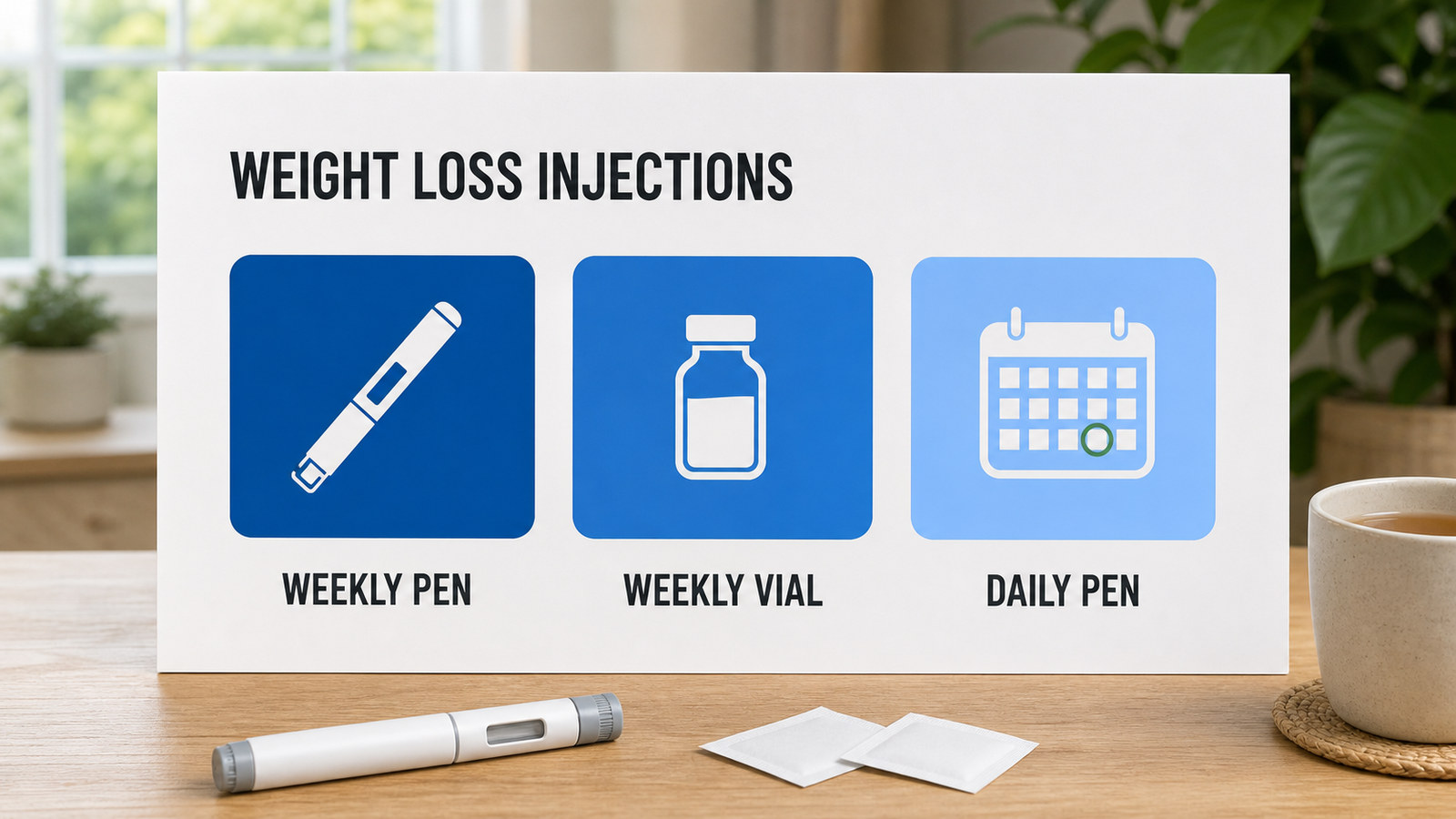
Almost everyone starting weight loss injections is nervous about the same ninety seconds, and almost everyone reports afterwards that the injection itself was the least dramatic part of the whole process. The needle on a modern subcutaneous pen is short and fine, the injection goes into fat rather than muscle, and most people describe the sensation as a pinch or nothing at all.
The parts that actually matter come before and after the ninety seconds. What is in the device, how you store it, which day you pick, whether you rotate the site, and above all where the medication came from. If you are still working out which product you want, a maintained rundown of weight loss injections is a useful map of the field, and our own guide to choosing a GLP-1 covers how the options differ. This guide is about the routine itself.
Which injections are actually weight loss medication
The phrase covers two very different categories, and confusing them is the most expensive mistake in this space.
Prescription incretin injections. These are the medications with weight-management approvals and trial evidence behind them: semaglutide (Wegovy), tirzepatide (Zepbound), and liraglutide (Saxenda). Their diabetes-labelled siblings, Ozempic, Mounjaro and Victoza, contain the same molecules and are sometimes prescribed off-label for weight. These are given subcutaneously, into the fat layer, using a pen or a syringe.
Everything else marketed as a weight loss shot. Lipotropic or MIC injections, vitamin B12 shots sold for metabolism, and HCG injections all get advertised in this category. The evidence that any of them produce meaningful weight loss is weak to absent, and the FDA has been explicit that HCG is not effective for weight loss. Injectable deoxycholic acid is a real approved product, but it dissolves a small pocket of fat under the chin for contouring purposes and has nothing to do with body weight.
There is a third group worth naming: vials sold online labelled for research use, or peptide blends with no named pharmacy behind them. These are not a cheaper version of the first category. They sit outside the approval and quality system entirely.
The three formats you will actually be handed
| Format | What arrives | What you do each time | Who it suits |
|---|---|---|---|
| Single-dose weekly pen | A prefilled, fixed-dose device, one per week | Uncap, press against the skin, hold for the counted seconds, dispose | Most people. The least room for a dosing error, because the dose is already set. |
| Multi-dose weekly vial | A vial plus separate syringes | Draw the correct volume yourself, check it, then inject | Lower-cost and self-pay routes. Requires you to measure accurately every single time. |
| Daily pen | A multi-dose pen you dial to a dose | Attach a new needle, dial, inject, remove the needle | Liraglutide users and people who would rather hang a small task on a daily routine. |
If you have any hesitation about drawing a dose from a vial, say so before you choose a program. Vial routes exist for good reasons, but a fixed-dose pen removes a whole category of mistakes, and that is worth something.
What injection day actually involves
The whole routine takes about a minute once it is familiar.
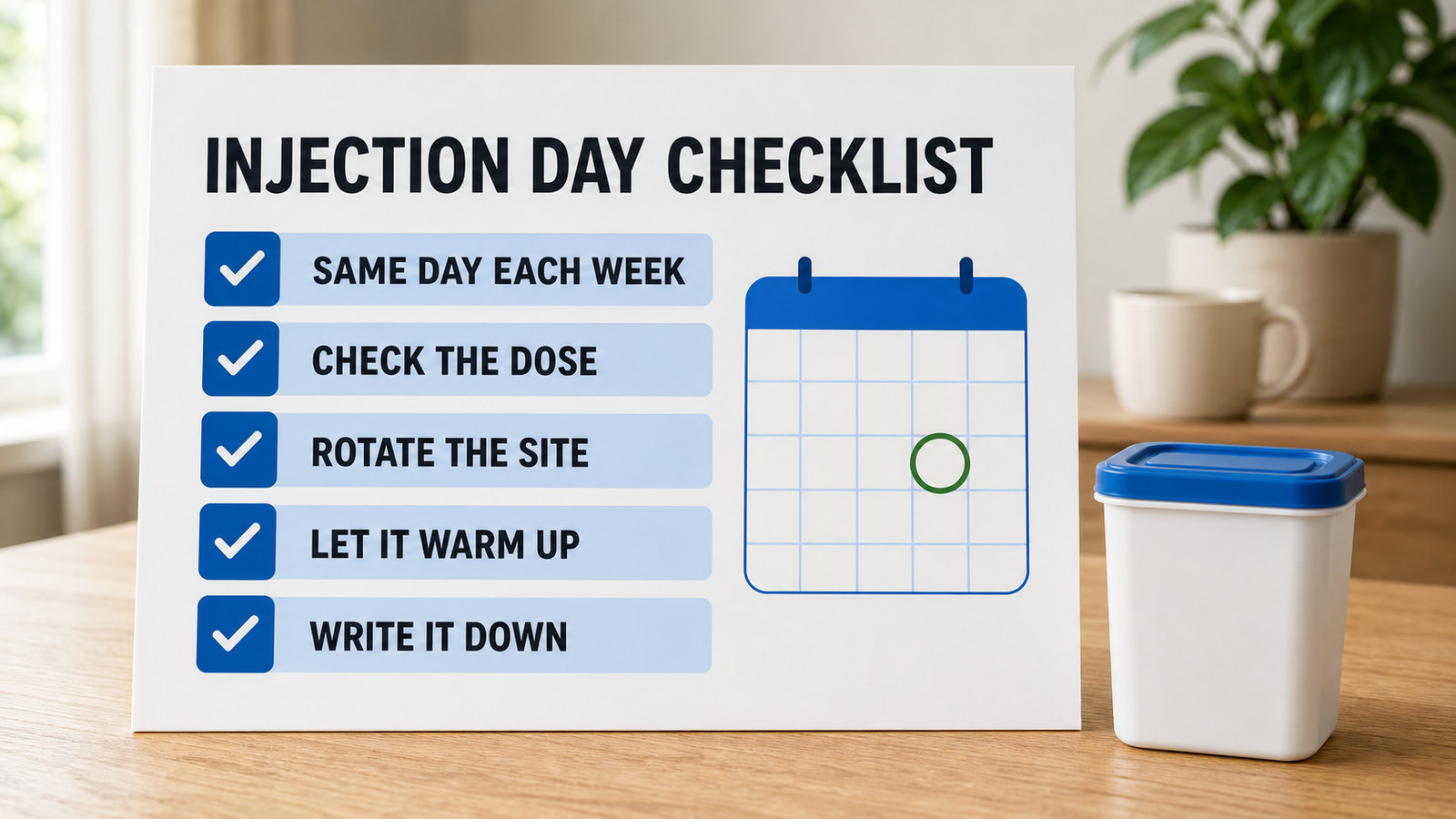
- Take the device out of the fridge. Many people find an injection more comfortable if the medication is not straight-from-the-fridge cold. Check your own label for what it permits.
- Check the dose. Confirm the strength on the label matches the step you are supposed to be on. This is the moment to catch a pharmacy error.
- Pick a site and rotate it. The abdomen a couple of inches away from the navel, the front of the thigh, and the back of the upper arm are the standard options. Use a different spot each week rather than the same square inch.
- Clean, inject, hold. Wipe the site and let it dry. Pens count down for a set number of seconds; take the device away too early and part of the dose ends up on your skin.
- Dispose of the sharp properly. A proper sharps container, not the kitchen bin.
- Write it down. Date, dose, site. Two months in, this is the record that tells you whether a rough week tracked a step-up or something else.
The mistakes that actually cause problems
Measuring in the wrong units. This is the big one. Dosing errors have been reported repeatedly with vials and syringes, where a dose described in milligrams has to be converted into a volume or into syringe unit markings. The FDA has flagged this specific hazard around unapproved and compounded GLP-1 products. If anyone hands you a vial without written, unambiguous instructions about how much to draw, stop and get them.
Treating the storage rules as optional. These are refrigerated products. Freezing generally ruins them, and each product has its own limited room-temperature window measured in weeks rather than months. Do not leave a pen in a hot car, and do not put medication in checked luggage where the hold temperature and the risk of losing the bag are both against you.
Drifting off the weekly slot. Weekly products are designed around a fixed day. The rules for a missed dose differ by product and are written in the label, so know yours in advance instead of improvising at 11pm. Our guides on choosing an injection day and the step-by-step pen technique cover the practical version of both.
Reusing one site. Repeated injections into the same small area are more likely to leave lumps, tenderness or redness. Most injection site reactions are mild and settle on their own, and simple rotation prevents most of them.
How to tell a safe seller from an unsafe one
Access is genuinely hard, which is exactly why the grey market is large. Run any source past this list before you send money.
- A real prescriber reviews you first. A form you fill in yourself, with no clinician assessment and no medical history, is not a prescription process.
- The pharmacy is named before you pay. If you cannot find out which pharmacy is dispensing and in which state it is licensed, that is the answer.
- The product is a finished, labelled medication. Anything sold as research material, or a vial of powder you are expected to mix yourself with no written protocol, is not a treatment plan.
- The full cost is explained by dose, not by headline. Ask what your total looks like at the maintenance dose, including consults, shipping and labs, rather than the first-month figure.
- It ships cold and arrives cold. Insulated packaging, a cold pack, and a stated plan for what happens if a delivery is delayed or arrives warm.
- There is a way to reach a clinician afterwards. Side effects and dose holds need a human being, not a chatbot and a refund policy.
Compounded products occupy a middle ground rather than the outer edge. They can be legitimate in specific circumstances through a properly licensed pharmacy, but the regulatory footing is different from an approved product and it is worth understanding that difference before you rely on it.
The injection is the small half of the job
The medication reduces appetite. It does not choose what you eat with the appetite you have left, and it does not protect lean mass on its own. The people who come out of a year on treatment happiest with their body composition, rather than just their scale weight, are almost always the ones who kept protein intake up and kept doing some form of resistance training the whole way through. Our guide on protecting muscle covers what that looks like in practice.
Hydration and fibre deserve the same early attention, because constipation is one of the most common reasons the first two months feel worse than they need to.
Common questions
Common Concerns
Do weight loss injections hurt?expand_more
Where should I inject?expand_more
What happens if I miss a weekly dose?expand_more
Are compounded weight loss injections the same medication?expand_more
How long before weight loss injections start working?expand_more
Keep exploring
Browse all GLP-1 guides on GLP1 Protocol, or start with the step-by-step injection guide.