Peptides for Dogs
The sequence from the first search to the vet's exam room, what a veterinarian can lawfully prescribe once a diagnosis exists, and why no dose appears anywhere on this page.
Peptides for dogs is a question that almost always arrives in the same order. The dog slows down, or limps, or stops holding food down. A search happens at eleven at night. A forum thread names a compound. A website sells that compound in a small glass vial, to anyone, with no questions asked. Somewhere along that chain a decision gets made about an animal that cannot consent to it, cannot refuse it, and cannot tell you afterwards whether it helped.
Here is the correction that matters most, and it is the opposite of what most pages on this topic say. It is not true that peptides are unapproved for dogs. Insulin is a peptide, and Vetsulin, a porcine insulin zinc suspension, is described by its manufacturer as the first FDA-approved insulin for use in dogs and cats with diabetes. Peptide medicines for dogs exist, veterinarians prescribe them every day, and none of them are the ones being sold on research-peptide websites. The dividing line is not peptide against not a peptide. It is which supply route the vial came down.
What follows is that sequence, one step at a time: the search, the thread, the vial, the exam, the diagnosis, the prescription and the recheck. You will not find a dose anywhere on this page, and the step that explains why is the one worth reading twice.
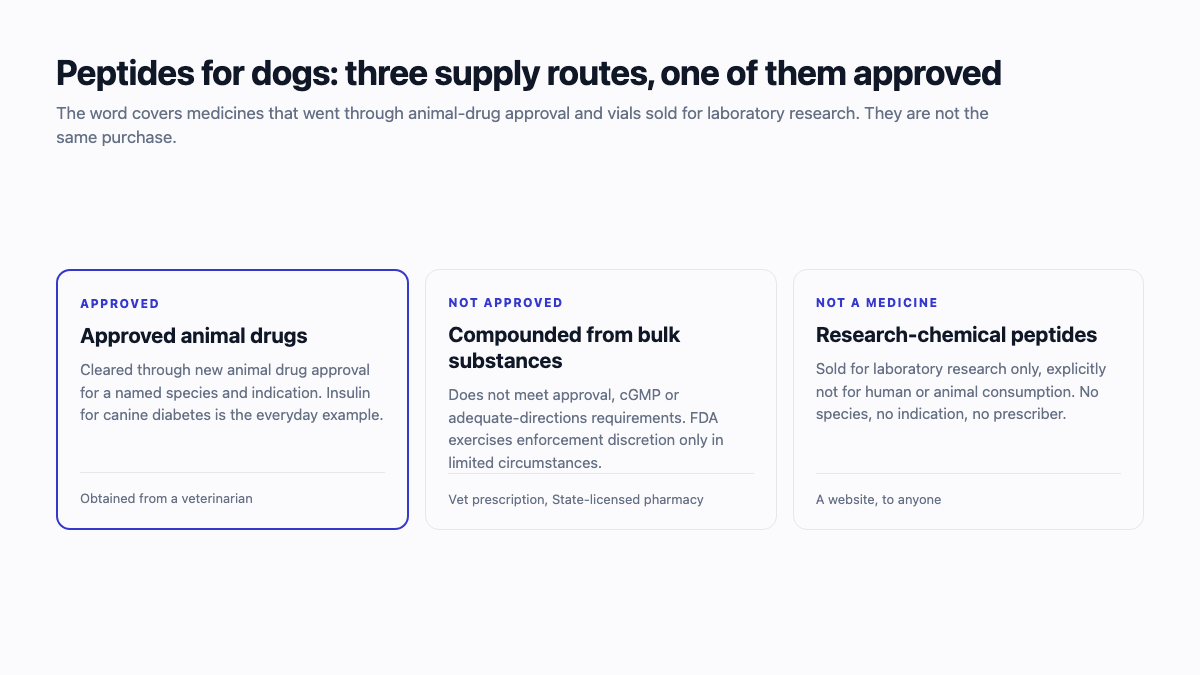
The card below is the third of those routes, the research-peptide lane described further down. It is laboratory material sold for laboratory use. It is not a veterinary medicine and it is not a route to treating an animal.
Where the order actually gets placed
Ascension Peptides, BPC-157
US-based, with no batch certificate published for this product. Enter the code on the payment step and either option halves before you confirm.
The Wolverine Stack is BPC-157 10 mg combined with TB-500 10 mg in one vial, so its per-mg figure spans both compounds. Quantity tiers take 3%, 5% or 10% off the list price; free shipping starts at $250.
- Two batch certificates per lot
- Shipping free over $250
- Out the door same day if you order before 2pm CST
Everything here is research material for laboratory use, not for human consumption. Affiliate links, so we may earn a commission at no cost to you. Prices last checked August 19, 2026.
Step one: what a search for peptides for dogs actually returns
The results split into three kinds of page, and they do not announce which kind they are.
There are veterinary pages about approved medicines, which tend to be written about a diagnosis rather than about a compound. There are research-peptide storefronts, which are written about a compound and never about a diagnosis. And there are owner forums and breed groups, which are where the compound name first gets attached to the symptom.
The forum thread is the important one, because it is usually the source of the idea. Read a few and the shape repeats: a named compound, a dog that was struggling, a post two weeks later saying he seems brighter, and then silence. No diagnosis before. No objective measure during. No follow-up post six months on, which is exactly when you would want one. The compounds that come up most are BPC-157, TB-500, GHK-Cu and KPV. If you want the compound-by-compound version of this discussion at greater length, PeptideDeck's guide to peptides for dogs covers each of them in detail.
What the thread cannot give you is the thing you actually need, which is a name for what is wrong with your dog.
Step two: the vial, and what the seller is really telling you
Research-peptide storefronts sell to anyone. No prescription, no exam, no account verification, no species on the label. Most of them carry a line saying the material is for laboratory research use only and not for human or animal consumption.
That line is not boilerplate anyone forgot to remove. It is the legal basis on which the product is sold at all. It is the seller stating, in writing, that the vial is not intended to go into a body, and it is what allows the transaction to sit outside the drug approval system entirely. An owner buying that vial to give to a dog is doing the one thing the label says it is not for.
Certificates of analysis complicate this in a way worth being precise about. A good vendor publishes purity by HPLC and identity by mass spectrometry against a lot number, and some publish endotoxin and sterility results too. That is real information and it is better than nothing. It also establishes far less than it appears to. A certificate describes a sample of a lot at one moment. It says nothing about what the compound does in a dog, nothing about a safe use, and it cannot confirm that the vial on your counter came from the material that was tested. Our breakdown of how to read a batch certificate goes through what each test does and does not prove.
Sterility and endotoxin matter more here than in the human market, not less. The animal is smaller, has no way to tell you that something feels wrong, and an owner injecting at home has no clinical monitoring running underneath.
Step three: the exam, which is the step that gets skipped
This is where the sequence usually breaks, and it is the step that determines everything after it.
An owner arrives at the vet with a compound in mind. The vet arrives at the same appointment with a symptom and no diagnosis. Those are not the same conversation. Slowing down in an older dog can be osteoarthritis, hypothyroidism, cardiac disease, chronic pain from an old injury, or early cognitive dysfunction. A limp can be a cruciate ligament, a soft tissue strain, immune-mediated joint disease or a bone tumour. Chronic gut trouble can be dietary, inflammatory bowel disease, pancreatic insufficiency, a foreign body or something worse.
The exam, the bloodwork and the imaging exist to narrow that list. Until it is narrowed, there is no coherent question about any treatment, because you cannot select a compound for a condition you have not identified. Several of the conditions owners try to self-treat also have approved veterinary drugs already, which is the outcome the forum thread never mentions.
There is a second reason this step is not optional. Your dog is not going to report a side effect. In every route that ends well, the veterinarian is the monitoring system, and monitoring has to start from a baseline that was taken before anything was given.
Step four: what a veterinarian can and cannot prescribe
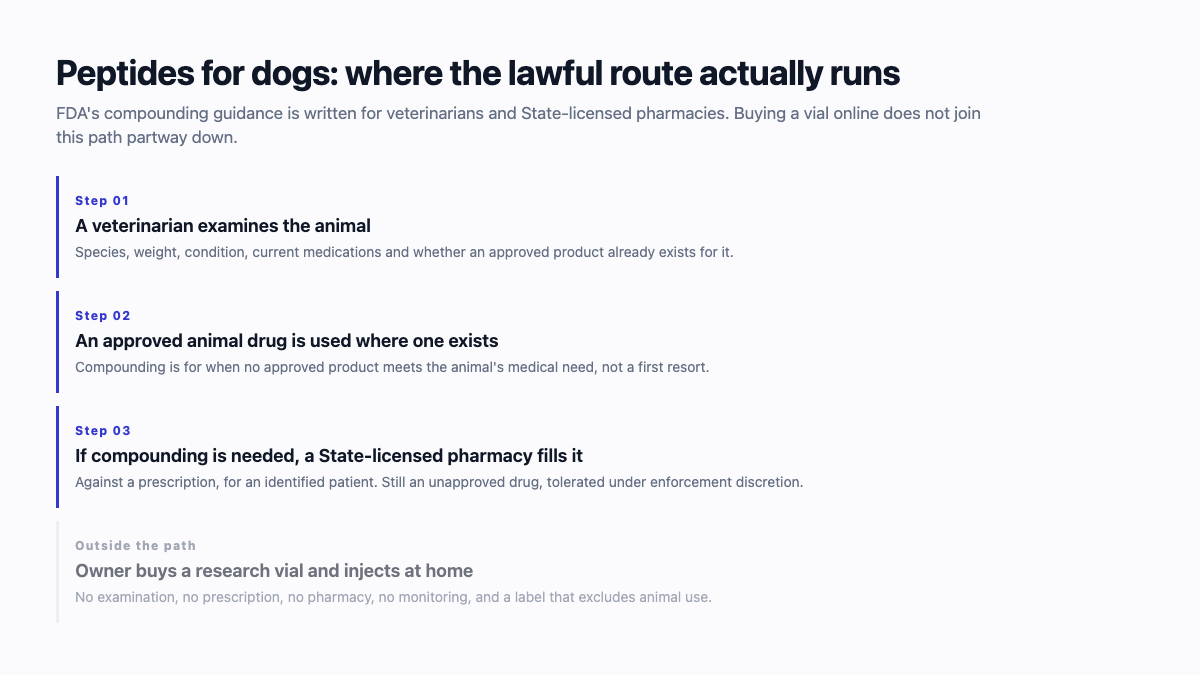
Once there is a diagnosis, three lanes exist, and only two of them are open to your vet.
Approved animal drugs. These went through new animal drug approval, which means FDA reviewed evidence of safety and effectiveness in the species, plus manufacturing and labelling. Insulin for canine diabetes is the everyday peptide example. This lane comes with a label, a known safety profile, an adverse event reporting route and a manufacturer who is required to use it.
Compounding. FDA states that the FD and C Act permits compounding of animal drugs when the source of the active ingredient is a finished FDA-approved drug, and not a bulk drug substance. Compounding from bulk substances is a separate situation, covered by FDA Center for Veterinary Medicine guidance GFI #256, docket FDA-2018-D-4533, which says:
Animal drugs that are compounded from bulk drug substances do not meet the FD&C Act's new animal drug approval, cGMP, or adequate directions for use requirements. However, FDA has generally exercised enforcement discretion with regard to animal drug compounding from bulk drug substances under certain circumstances.
Two details in that guidance change what it means for a pet owner. First, it is stated to be intended for veterinarians, State-licensed pharmacies and Federal facilities. The tolerated route runs through a professional and a licensed pharmacy, so someone ordering a vial from a website is not inside those circumstances at all. Second, enforcement discretion is not approval. FDA frames it as its current position based on its current understanding of the risks, which means it is conditional and can be revised. FDA also notes that compounded animal drugs lack post-market controls, and that compounders are not required to report adverse events or product defects the way sponsors of approved drugs are. The same approved-against-compounded distinction plays out on the human side, which the compounded versus brand comparison works through in detail.
Research chemicals. There is no lane here. No approved indication, no prescription route, no pharmacy, no oversight, and a label that says the material is not for animal consumption.
| Route | Regulatory status | Who can supply it |
|---|---|---|
| Approved animal drug | Reviewed for safety and effectiveness in the species | Your veterinarian, a pharmacy |
| Compounded from a finished approved drug | Permitted under the FD and C Act | A veterinarian or pharmacist, on a prescription |
| Compounded from a bulk drug substance | Not approved. Enforcement discretion in limited circumstances | A veterinarian's prescription, filled by a State-licensed pharmacy |
| Research-chemical peptide | Sold as laboratory material, not for animal consumption | A website, to anyone |
Step five: what the evidence base actually contains
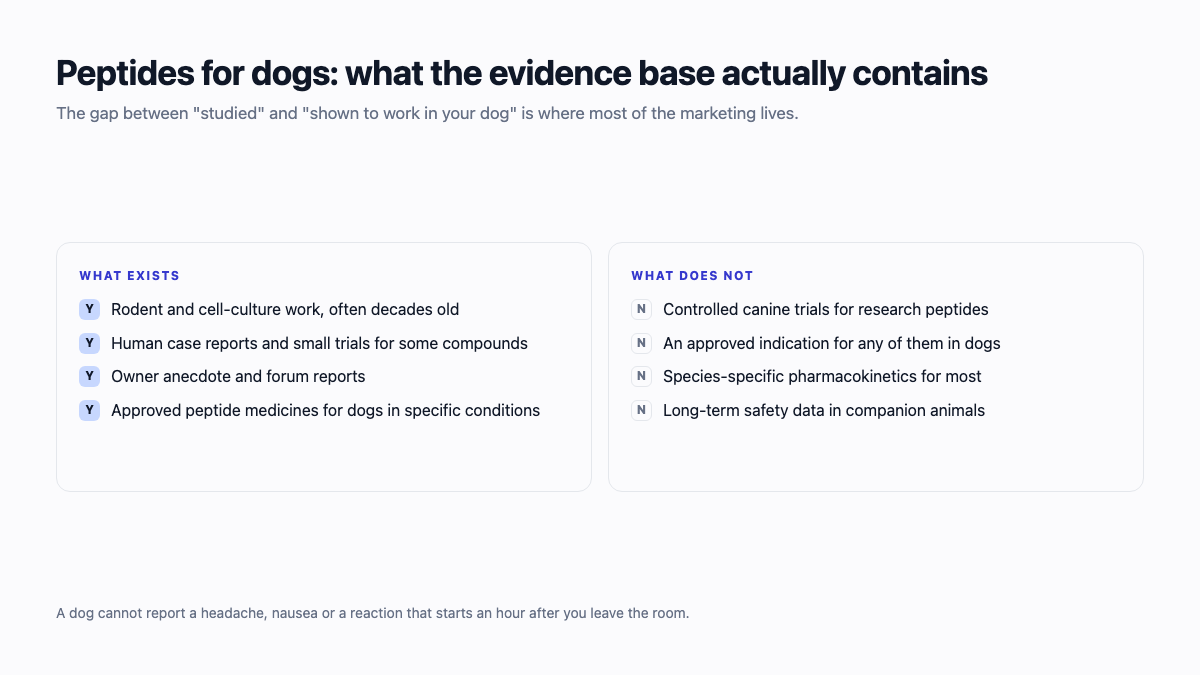
For the research peptides in this conversation, what exists is rodent work, cell culture work, patent filings and owner anecdote. The 2025 review of BPC-157 in Pharmaceuticals is explicitly a literature and patent review, which is a fair description of the state of that field.
What does not exist is a controlled trial in dogs with a defined endpoint, a published canine safety profile, or an approved indication in the species. Human data does not close that gap either. Different species metabolise things differently, arrive at very different body sizes, and only one of the two can tell you that something feels wrong.
The anecdote problem is more specific than general scepticism, and it has been measured in dogs. In a placebo-controlled trial of 58 dogs with lameness from osteoarthritis, a caregiver placebo effect occurred 39.7 percent of the time when owners assessed their own dog, and 44.8 percent of the time when veterinarians assessed lameness at a walk. Force platform gait analysis on the same dogs, all of them on placebo, showed no change. The effect got stronger the longer the trial ran.
That is the honest reading of every thread that says he seems brighter this week. Roughly two owners in five will report improvement in a dog receiving nothing at all, and they are not being dishonest. It is why an approved medicine needs an objective measure and a control group, and it is why a hundred forum posts do not add up to one.
Step six: what follow-up looks like when treatment does start
The step after the prescription is the one that separates the routes most clearly.
On an approved medicine, the veterinarian sets the dose, and the dose is theirs to set because it comes from studies in the species and from your dog's diagnosis, weight and bloodwork. Then there is a recheck. Bloodwork or imaging gets repeated, the response gets measured against the baseline taken before treatment, and the plan gets adjusted. There is a written record, there is somebody to call at two in the morning, and if something goes wrong there is a reporting route that feeds back into what is known about the drug.
A vial injected at home has none of that. No baseline, no recheck, no adjustment, no record, no reporting route. The earliest sign of a problem is a behaviour change that an owner has to notice and interpret without a clinical reference point, in an animal that hides pain by instinct. That asymmetry, rather than any argument about the compounds themselves, is the strongest reason this sequence ends at a veterinarian.
Five questions worth asking before anything is injected
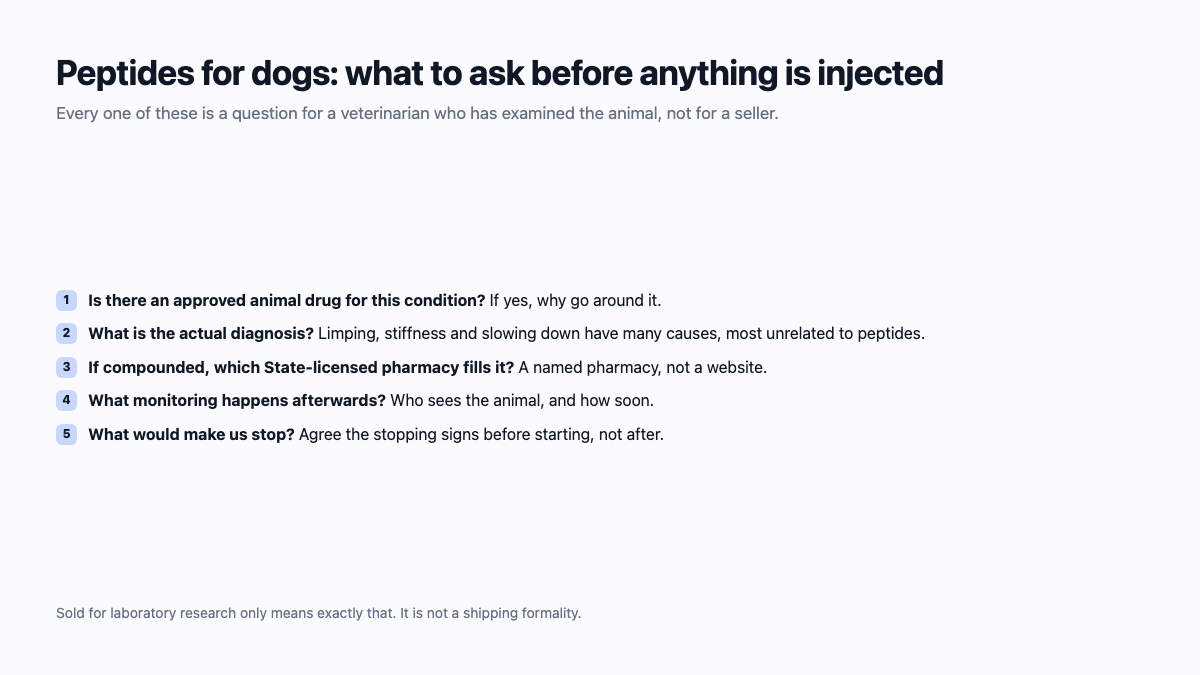
Take these to the appointment. They work whether your vet suggests a treatment or you do.
- What is the diagnosis, and what is it based on? Ask which findings, images or results support it, and what else is still on the list.
- Is there an FDA-approved animal drug for this diagnosis? If there is one and it is not the first choice, the reason is worth hearing.
- If something compounded is being proposed, which route is it? Compounded from a finished approved drug, or from a bulk drug substance, and which State-licensed pharmacy is filling it.
- What would tell us this is working, and by when? Ask for something measurable rather than an impression, given how the caregiver placebo numbers look.
- What are the early warning signs in a dog that cannot tell me? Which changes mean call immediately, and who answers out of hours.
If a product is being offered without a diagnosis, without a pharmacy behind it and without an answer to question four, the sequence has broken somewhere and the vial is not the part to fix first.
Common questions
Common Concerns
Are any peptides FDA approved for dogs?expand_more
Can I give my dog BPC-157 that I bought from a research website?expand_more
Will a veterinarian prescribe a compounded peptide for my dog?expand_more
A certificate of analysis is published for the vial. Does that make it safe for my dog?expand_more
Owners in the forum thread say it worked. Why is that not enough?expand_more
Why will nobody give me a dose for my dog?expand_more
Keep exploring
For the prescription question on the human side of the same compound, BPC-157 without prescription traces the regulatory dates that decide what is available to whom.
Sources
- FDA CVM GFI #256: Compounding Animal Drugs from Bulk Drug Substances (docket FDA-2018-D-4533)
- FDA: Animal Drug Compounding
- Vetsulin (porcine insulin zinc suspension), Merck Animal Health
- Caregiver placebo effect for dogs with lameness from osteoarthritis (JAVMA, 2012)
- Multifunctionality and Possible Medical Application of the BPC 157 Peptide: Literature and Patent Review (Pharmaceuticals, 2025)